
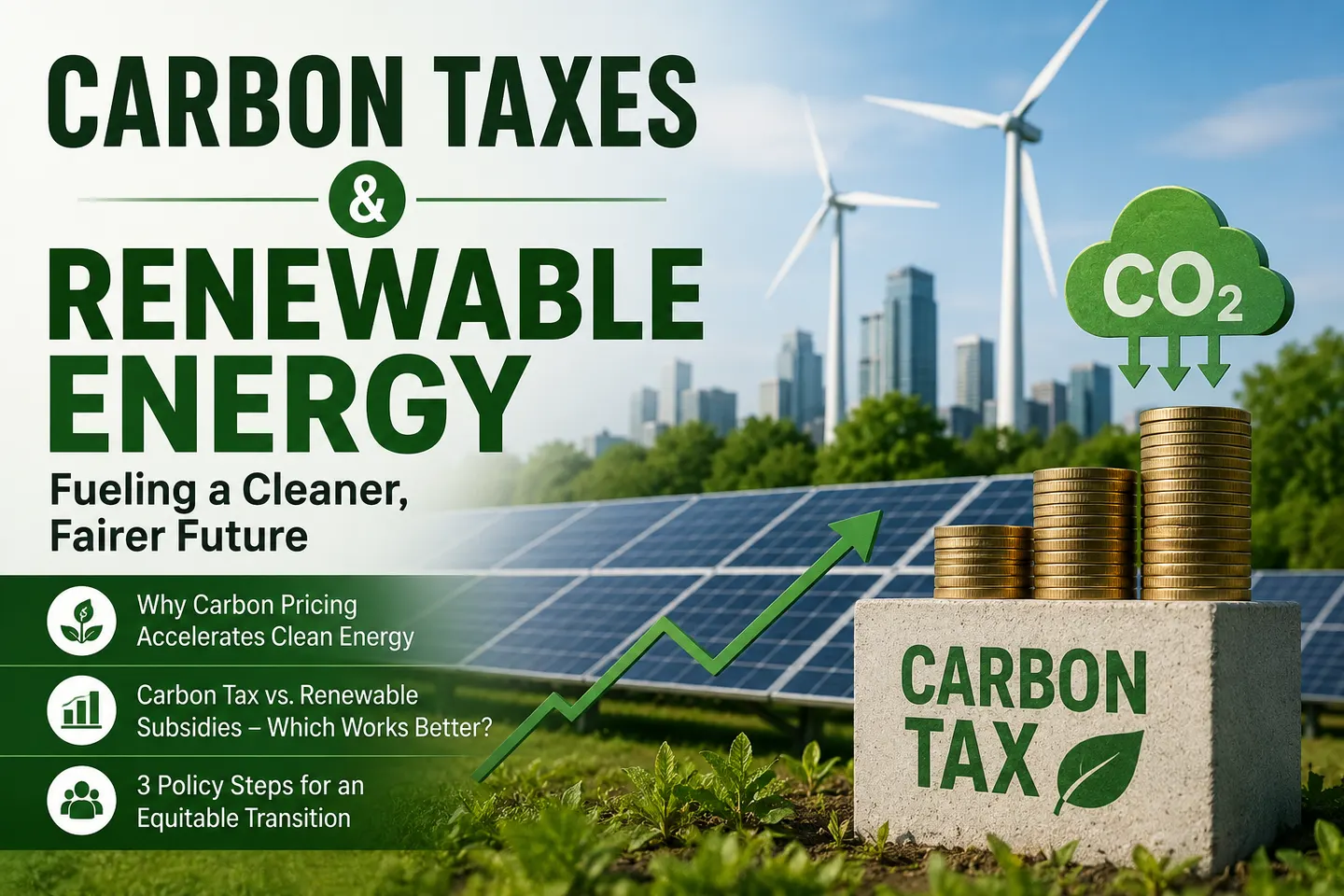
The clean energy transition is not only a technology challenge. It is also a market design challenge. Solar, wind, battery storage and other low-carbon technologies must compete with fossil-fuel energy systems that often do not fully reflect the environmental cost of their emissions.
A carbon tax changes that equation. By placing a direct price on carbon dioxide emissions, governments can make high-emission energy more expensive while improving the relative economics of renewable energy, storage and energy efficiency.
Carbon pricing is already a major climate-policy instrument. According to the World Bank's State and Trends of Carbon Pricing 2026, direct carbon pricing now covers just over 29% of global greenhouse gas emissions across 87 implemented policies, and those instruments generated more than US$107 billion in public revenue during 2025.
How does a carbon tax support renewable energy?
A carbon tax places a cost on each tonne of greenhouse gas emissions. For fossil-based electricity generators, this raises the operating cost of coal, oil and natural gas in proportion to their carbon intensity. Renewable technologies such as solar and wind have little or no fuel-related carbon emissions during operation, so their relative cost position improves.
The pathway runs: carbon price → higher cost of emitting → improved competitiveness of clean energy → more investment in renewables and storage → lower emissions.
1. It changes investment economics. When emitting carbon becomes more expensive, investors begin to price the future carbon cost of fossil-fuel assets. New coal or gas projects may therefore look less attractive relative to solar, wind, BESS and other low-carbon options.
2. It rewards cleaner technologies without choosing a winner. A carbon tax does not need to mandate one technology. It prices emissions and allows companies to choose the most cost-effective response, whether that is renewables, storage, efficiency, electrification or cleaner processes.
3. It improves long-term price signals. Renewable projects often operate for 20 to 30 years. A credible and gradually rising carbon price signals that high-carbon assets will face increasing economic pressure, which in turn influences PPAs, generation investment, corporate procurement and industrial electrification.
4. It generates public revenue. Unlike a subsidy, which requires government expenditure, a carbon tax raises revenue. That revenue can support household rebates, grid upgrades, storage, renewable-energy access, public transport and workforce transition.
Carbon tax versus direct renewable subsidies
Both tools can accelerate decarbonisation, but they work differently. A carbon tax primarily penalises pollution, while a renewable subsidy primarily rewards clean investment. In practice, the strongest policy packages use both.
| Factor | Carbon tax | Direct renewable subsidies |
|---|---|---|
| Basic approach | Makes carbon-intensive energy more expensive | Makes renewable energy cheaper |
| Economic efficiency | Generally high, because emitters face a common incentive | Can be high when targeted well, but eligibility must be defined |
| Government finances | Generates public revenue | Requires public expenditure |
| Technology neutrality | Strong | Lower, because support targets selected technologies |
| Speed of deployment | Can be gradual if the starting price is low | Can be rapid when incentives improve project economics |
| Investment signal | Strong if the future price path is predictable | Strong for supported technologies |
| Political feasibility | Often harder, because energy-price effects are visible | Often easier, because benefits are visible |
| Consumer impact | Can raise prices unless revenue is recycled | Can lower project costs, but uses public funds |
| Market impact | Economy-wide | Focused on supported sectors or technologies |
| Best use | Broad emissions reduction | Accelerating strategic technologies and markets |
Why carbon pricing alone is not enough
Carbon pricing improves the economic signal, but it cannot remove every barrier facing renewable energy. Projects can still be delayed by transmission congestion, slow permitting, land constraints, financing costs, grid-connection delays, storage requirements and regulatory uncertainty.
What works is the combination: carbon pricing, renewable auctions, grid investment, storage incentives, streamlined approvals and energy-efficiency programmes.
Three ways to make a carbon tax fair for consumers
- Return part of the revenue directly to households. Direct cash transfers, electricity-bill credits, tax rebates or targeted energy allowances, with larger support for lower-income households.
- Use revenue to reduce household energy consumption. Support for rooftop solar, residential batteries, efficient cooling, heat pumps, insulation, efficient appliances, community solar and electric mobility. This reduces long-term exposure to energy-price increases rather than only compensating for them.
- Invest in the infrastructure consumers need. Transmission and distribution upgrades, EV charging, battery storage, public transport, rural clean-energy infrastructure and renewable-energy access.
The two should work together
The better policy question is not "carbon tax or renewable subsidy?" It is which combination of policies delivers the fastest transition at the lowest social and economic cost.
Carbon pricing addresses the environmental cost of emissions. Subsidies address financing and deployment barriers. Grid investment solves infrastructure constraints, and consumer-support programmes address affordability. Each does something the others do not.
What does this mean for businesses?
For commercial and industrial consumers, carbon pricing changes how energy projects are evaluated. Businesses increasingly need to account for future carbon costs, renewable PPAs, rooftop solar, captive renewable projects, battery storage, energy efficiency, electrification, emissions reporting and carbon-border rules.
Energy-cost management, carbon-risk management, energy security and sustainability strategy stop being separate conversations. Taken together, they strengthen the business case for integrated Solar, BESS and energy management systems.
Conclusion
The transition to renewable energy requires technology, infrastructure, capital and the right market signals. Carbon taxes can improve the economics of renewable energy, discourage carbon-intensive investment, and generate revenue that governments can reinvest in consumers and clean-energy infrastructure.
The most effective approach combines a predictable carbon price, targeted renewable support, modern grids, energy storage and consumer protection.
Clean energy should not only reduce carbon. It should create a more reliable, affordable and sustainable energy system for everyone.
Selected references
- World Bank, State and Trends of Carbon Pricing 2026.
- International Monetary Fund, climate policy and energy subsidy research.
- International Energy Agency, Renewables 2025 and policy interaction research.