
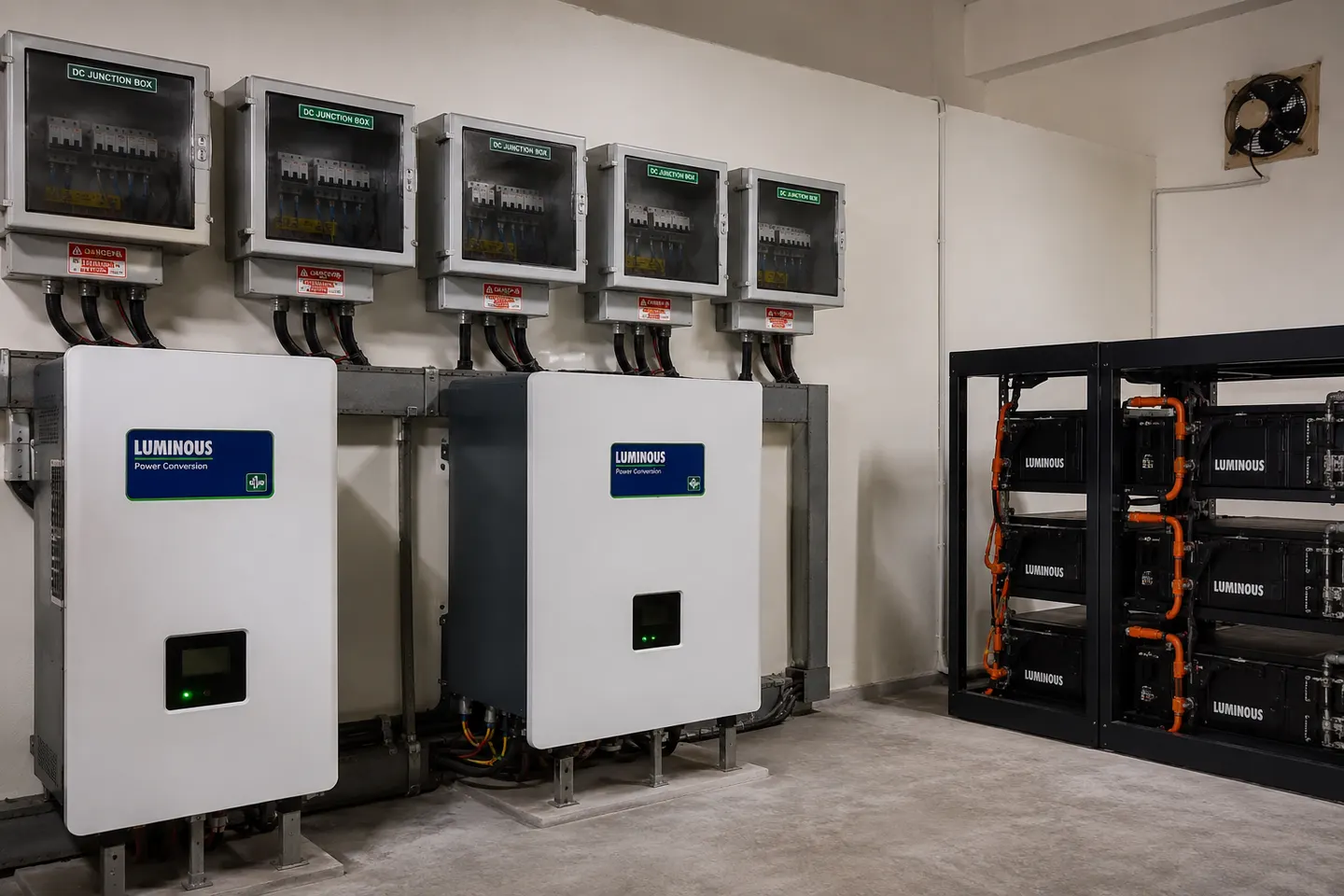
Businesses that have already adopted solar power have addressed their daytime electricity costs. However, most commercial and industrial operations in Karnataka face their highest costs in the evening, when solar generation has ended and grid tariffs or diesel backup become significantly more expensive. A Battery Energy Storage System (BESS) is designed to address this gap.
Four reasons to consider this now
- Evening peak. Guest floor demand, production shifts, and core business hours typically peak precisely when solar generation falls to zero.
- Expensive backup. Diesel generators typically cost Rs. 20 to 25 or more per unit to operate, and are increasingly subject to noise and emissions restrictions.
- Wasted solar. Midday solar surplus that cannot be consumed on site is exported to the grid, typically at a lower credit than its actual value.
- Reliability. A power outage during business hours or a critical operation carries a cost that is not always easy to quantify.
How a BESS works
Solar power can be compared to a tap, and a battery to a tank. Rooftop panels generate more electricity than can be consumed around midday. This surplus is stored in the battery rather than exported. In the evening, when the grid or a diesel generator would otherwise incur high costs, the battery discharges to power the facility at a fraction of the cost.
The daily operating cycle runs: solar generates during the day, the battery charges on the surplus, evening peak demand arrives, and the battery powers the load.
The financial case, in numbers
A worked example based on Karnataka's tariff structure, not a generic estimate.
| 100 kWp commercial facility | Solar only | Solar + battery |
|---|---|---|
| Upfront cost | ~Rs. 42 lakh | ~Rs. 99 lakh |
| Savings every year | ~Rs. 13.7 lakh | ~Rs. 24.6 lakh |
| Years to pay back | ~3.1 years | ~4.0 years |
Based on the BESCOM/KERC LT-3 Commercial tariff (Rs. 8.92 per unit plus duty), applicable uniformly across Karnataka's discoms, including BESCOM, CESC, HESCOM, GESCOM, and MESCOM. Diesel offset is assumed at approximately Rs. 20 per unit, a typical local market rate. Battery capital cost reflects the current 28% GST on lithium-ion cells; industry bodies have proposed a lower uniform rate, which would further improve payback if adopted. These figures are illustrative and will be refined following a review of the client's site and utility bills.
How to interpret this comparison: Solar alone delivers a marginally faster payback. Adding battery storage extends the payback period, but nearly doubles the annual savings, and is the only option that also replaces diesel backup and provides protection against evening outages. The right choice depends on whether the priority is the fastest payback or the greatest long-term saving.
Two sectors, two different cases
Hospitality: hotels and resorts. Diesel generation is often the largest hidden cost for a hotel or resort. A correctly sized battery can supply evening banquet and guest-floor loads, substantially reduce diesel usage, and provide a credible sustainability narrative for corporate and MICE clients who require one.
C&I and industrial: factories and warehouses. For facilities that already have rooftop solar, a battery captures midday surplus currently exported at a low credit, and uses it to offset the most expensive time-of-day peak charges. This is often complemented by a review of sanctioned demand, which can generate additional savings independently.
Where the policy stands
Karnataka state policy (RE Policy 2022–27, Notification ENERGY/209/VSC/2021). Energy storage is one of eleven designated focus markets under this policy, which targets 10 GW of new renewable capacity by 2027 and recognises storage as a means of reducing diesel dependency for C&I consumers. Behind-the-meter systems are governed by ESCOM net-metering rules (KERC 2016), not the IPP allotment process.
Captive rules rewritten (Electricity (Amendment) Rules 2026, G.S.R. 186(E), 13.03.2026). Electricity drawn through a battery between a captive plant and its user now qualifies as valid captive consumption, resolving an ambiguity that made group-captive solar-plus-BESS structures difficult to finance and defend.
DSPV storage mandate (draft) (Draft KERC (Grid Interactive DSPV Plants) Regulations 2026, Notification KERC/F-34/V-38/2026-27/2060, 02.06.2026). Under this draft regulation, DSPV consumers above 10 kW opting for net metering, net billing, gross metering, or group or virtual net metering must install a hybrid inverter and battery storage system sized at a minimum of 20% of the plant's generation potential. Behind-the-meter systems are exempt. Currently open for stakeholder consultation, this signals storage moving from optional to expected for most grid-connected commercial solar above 10 kW in the state.
This regulatory information is current as of mid-2026 and is provided for general context only. It does not constitute legal or tax advice. The KERC DSPV Regulations 2026 remain in draft form as of this writing and are subject to change before finalisation. Applicability, thresholds, and timelines should be confirmed with a qualified advisor before structuring a captive or open-access arrangement.
How implementation works
- Share electricity bills. Twelve months of electricity bills are required to begin the assessment.
- Site visit and assessment. A site visit to review load patterns and available roof or land area.
- Techno-commercial proposal. A detailed assessment of sizing, safety, and payback, based on actual data.
- Installation and commissioning. EPC execution, including all required safety approvals and sign-offs.
- Monitoring and support. Ongoing performance monitoring to ensure continued results.
System overview
A simple single line diagram runs: Solar PV (rooftop generation, DC) → Inverter (converts DC to AC) → Battery (stores surplus, discharges as required) → AC panel (combines and distributes AC power) → Meter (records import and export) → Grid and load.
The grid remains connected at all times, supplementing supply if the battery is depleted and accepting genuine surplus under net-metering. The system is designed to draw on solar and battery storage first, with the grid serving as a secondary source. Remote monitoring, typically through an EMS and a cloud-based application, provides visibility into generation, storage, and consumption data.
Request a site-specific assessment
Karnataka-specific modelling. No-obligation site read. Full techno-commercial view. Submit twelve months of electricity bills for a detailed, site-specific assessment at no obligation.